COMPLIMENTARY CONSULTATION FOR NEW CLIENTS

THE TRANSFORMATION
The Marigold Chair — The Chair That Started It All
This chair was my first solo transformation.
I had just completed two upholstery courses and had come away a little frustrated. The classroom had only one sewing machine, and there weren't enough air hoses for everyone to use their staple guns at the same time. I figured that instead of spending more money on tuition, I might as well invest in my own tools and learn by doing.
So I started looking for chairs on Facebook Marketplace. The first few chairs I found within my budget were snapped up before I could get to them. Then I fell in love with a free Louis-style armchair. I sent several messages to the seller, asking when I could come and pick it up, but never received a reply.
By the time I spotted this chair, I was getting a little nervous about missing another opportunity. I contacted the seller, who confirmed that it was still available. We agreed on a price and a time for pickup. When I arrived, I met a rather young seller who mentioned that the chair was a little wobbly. But he assured me that it was "nothing a little glue can't fix." I liked the look of the chair, and I decided to take my chances.
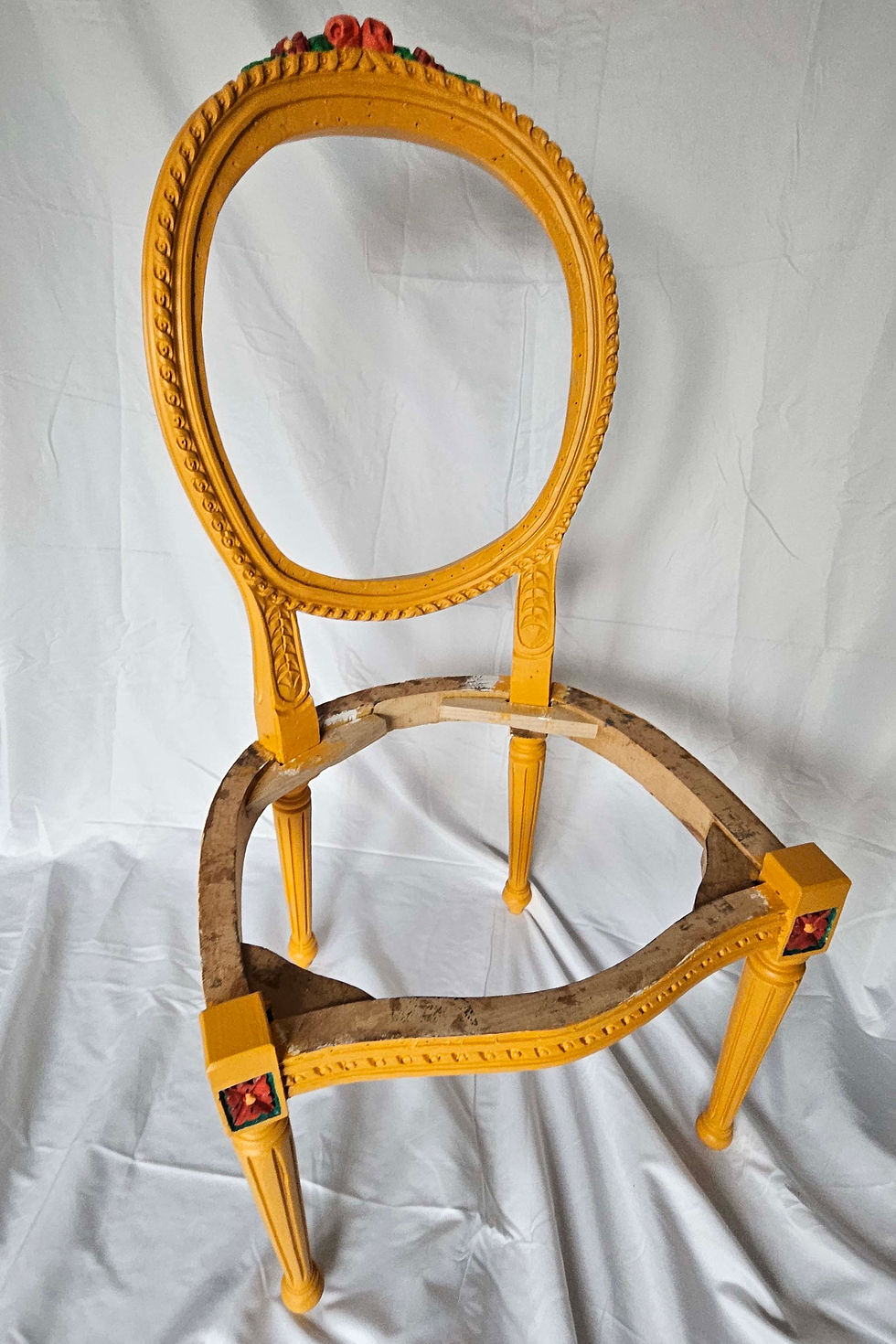
Once home, I gave it a proper photo shoot. I wanted some good "before" pictures to document what I expected would be a fairly straightforward transformation.
Then I started removing the old upholstery. It quickly became apparent that a little glue wasn't going to fix anything. In fact, it seemed as though the fabric itself had been holding the chair together! The main tenons at the back of the seat frame had sheared right through. I wasn't about to accept defeat, so I went down a deep (very deep) rabbit hole of chair construction and structural repair.
I discovered that this kind of failure is relatively common in chairs with rounded seat frames. Rather than bending the wood to create the curve, manufacturers sometimes cut curved pieces from straight boards. At the front of the frame, the wood fibres run more or less in the direction of the load, giving the structure strength. But at the back, where the curve meets the joints, the grain runs at an angle. Over time, repeated stress can cause the wood to shear. Suddenly, I understood why my chair had fallen apart.
Understanding the problem, however, was one thing. Fixing it was another. I had to find suitable pieces of hardwood, buy a coping saw, and teach myself how to cut angled tenons and form matching mortises. Progress was frustratingly slow. I watched countless YouTube videos, experimented, made mistakes, and tried again.
Eventually, I had a solid chair frame. Only then could I turn my attention to the part of the project I had originally been looking forward to: giving the chair a new personality. I found a vibrant floral fabric featuring marigolds, and it immediately caught my eye. I decided to paint the wooden frame in a matching shade of yellow. For the seat, I chose a deep, rich teal velvet that would contrast beautifully with the flowers.
The carved floral details on the frame gave me another idea. Rather than painting them all yellow, why not pick out the individual flowers in different colours? It was a small detail, but one that brought the whole design together. And so the Marigold Chair began to take shape. After everything I had been through repairing the structure, the actual upholstery seemed almost straightforward. For once, things went more or less according to plan!
When I finally stepped back to look at the finished chair, I was delighted. What had begun as a modest first project had become something much more ambitious. And I had learned far more than I ever expected.
They say that the best-laid plans rarely survive first contact with the enemy. I couldn't agree more. I would add that some of the most valuable experience comes from navigating a crisis. When things go wrong, you're forced to venture beyond what you've learned in classrooms or textbooks. You have to understand the problem, experiment, make mistakes, and find your own solutions. I've since discovered that almost nothing is straightforward in upholstery.
And I suspect that's precisely why I love it so much.
The Marigold Chair
Where Chair Salon began. This vintage armchair was brought back to life with a vibrant marigold print, rich teal velvet, and a sunny yellow frame with hand-painted floral details. Behind its cheerful appearance lies quite a story of discovery, determination, and a few unexpected challenges.
01 — WHERE IT BEGAN


02 — UNCOVERING THE DAMAGE


03 — STRUCTURAL REPAIR

04 — MULTICOLOURED FLOWERS AND CHAIR DETAILS